
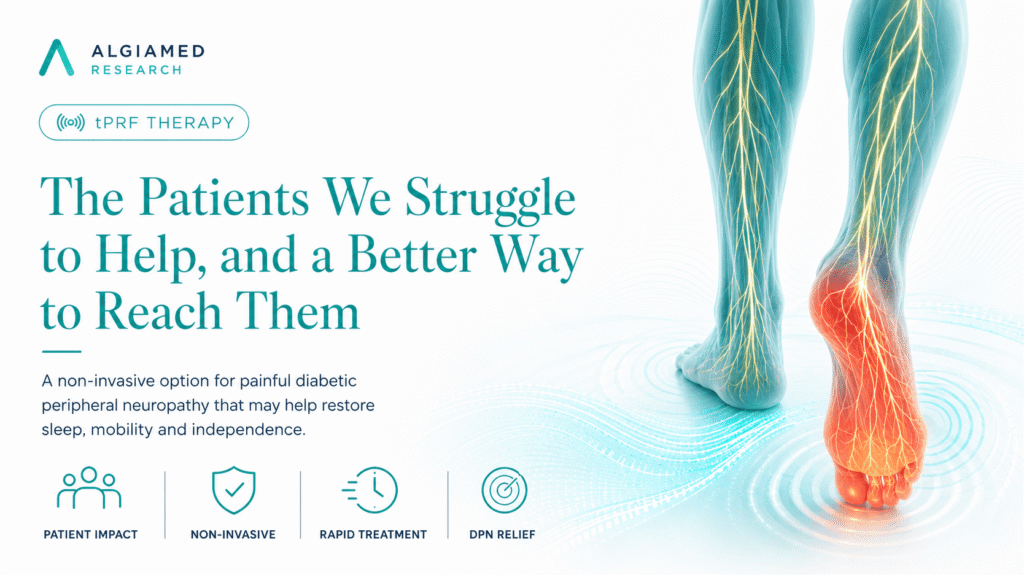
Every clinician who manages diabetes has the same patients in mind. The ones who describe burning feet that keep them awake at night. The ones who have stopped walking the dog, stopped standing long enough to cook, stopped sleeping through the night. The ones who have tried two or three medications, each trading a little relief for grogginess, dizziness or nausea, and who eventually stop asking because they have concluded nothing more can be done.
Painful diabetic peripheral neuropathy (DPN) is one of the most common and most undertreated complications of diabetes. Roughly half of the 40 million American adults with diabetes will develop neuropathy, and of those, an estimated 30 to 50 percent live with the pain it causes.¹⁰ For many, that pain becomes a permanent companion. It is not just a clinical problem; it is a quality-of-life problem that touches sleep, mood, mobility and independence.
Why current options leave a gap
The standard pharmacologic approach — antidepressants, antiepileptics, opioids — helps some patients, but the honest data are sobering. Across guideline agents, roughly five patients must be treated for one to achieve a meaningful response, and responders typically experience only around a 30% reduction in pain.⁶ Only a minority respond at all, and side effects frequently drive patients to stop. For those who exhaust medications, the next option has traditionally been a surgically implanted device — effective for selected patients, but carrying the real risks of any implant.
In other words, many patients with painful DPN find themselves caught between long-term medication management and invasive surgical intervention, with few practical treatment options available in between. It is within this treatment gap that countless patients continue to struggle.
A different kind of option
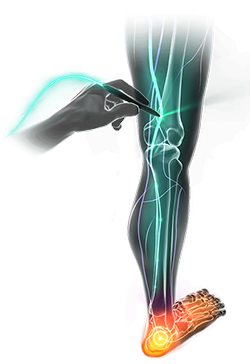
STIMPOD® NMS460 is now FDA-cleared for the relief of mild to moderate neuropathic pain associated with diabetic peripheral neuropathy of the lower extremities.¹
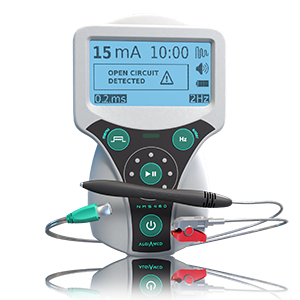 What makes it different is not only how it works, but how little it requires from the patient:
- It is non-invasive and drug-free. No implant, no incision, no new pill.
- It is fast. Treatment sessions last 10 minutes and only need to be repeated a few times.
- It is comfortable. No anesthesia, no recovery, no downtime. Patients walk in and walk out.
- It is portable. The device fits in the palm of your hand, so treatment can come to the patient. They can be in the clinic they already visit, no need for a distant specialist center.
Why it fits clinical practice
STIMPOD is not a conventional TENS device. It delivers a patented hybrid radiofrequency waveform (a monophasic square wave with a superimposed high-frequency RF burst), and is, to our knowledge, the only FDA-cleared device delivering this patented waveform non-invasively, without an implant, with a specific DPN-pain indication.³
- Non-invasive and drug-free. No implant, no surgical risk, no systemic drug exposure, no additive side-effect burden in patients already managing complex comorbidities.
- Minimal treatment burden. Three 10-minute sessions versus daily medication or the multi-month, multi-session schedules of other device-based approaches.
- Fits your workflow. A handheld unit that fits in your palm, with no anesthesia, recovery or downtime. Treatment can be delivered chairside in pain, podiatry, diabetes, rehabilitation, wound-care and primary-care settings.
- Well tolerated. No device-related adverse events were reported in the pivotal study, supporting use in patients for whom medication tolerability is a limiting factor.
For the right patient, STIMPOD offers something the current pathway rarely does: meaningful, rapidly-onset relief without asking the patient to trade one burden for another.
Proven Results
In a randomized, placebo-controlled trial, a single course of three sessions produced relief that was measured immediately and remained significant at three months.² Nearly half of treated patients were responders on the Brief Pain Inventory at one month, more than double the placebo rate, and the effect held even after accounting for age, baseline pain and the medications patients were already taking.² No procedure- or device-related adverse events were reported.
For a clinician, that combination — rapid onset, durable benefit, and a clean safety profile — is rare. It means you can offer a patient relief without asking them to accept new risks or a heavier daily burden of treatment.
Why it matters beyond the exam room
 There is a larger story here, too. Severe painful DPN is associated with total annual all-cause healthcare costs of approximately $27,000 to $31,000 per patient, driven largely by hospitalizations and disease-related complications rather than by the medications themselves.⁹ When pain is poorly controlled, patients move less, heal slower, and progress toward the costly complications that drive those numbers up. A low-burden, well-tolerated treatment option that helps patients engage with earlier, more effective pain control speaks directly to that trajectory.
At Algiamed, we think of this as more than symptom management. Our work focuses on the body’s internal communication network and the control systems that govern it — an approach we call neuro-remodelling — and how carefully applied, non-harmful stimuli can help a maladapted system return toward its natural state of function. For the patient sitting across from you, who will be unable to sleep tonight because of their pain, that vision starts with something simple: thirty minutes, no needles, no downtime, and a real chance at relief.
A clear, patient-friendly explanation of transcutaneous pulsed radiofrequency therapy, how...Read More

A clear, patient-friendly explanation of transcutaneous pulsed radiofrequency therapy, how...Read More
Chronic pain doesn’t begin—and certainly doesn’t persist—inside the nerve alone....Read More
This article examines emerging research into mitochondrial dysfunction, cellular energy,...Read More