Step 1: The Era of Heat (Radiofrequency Ablation)
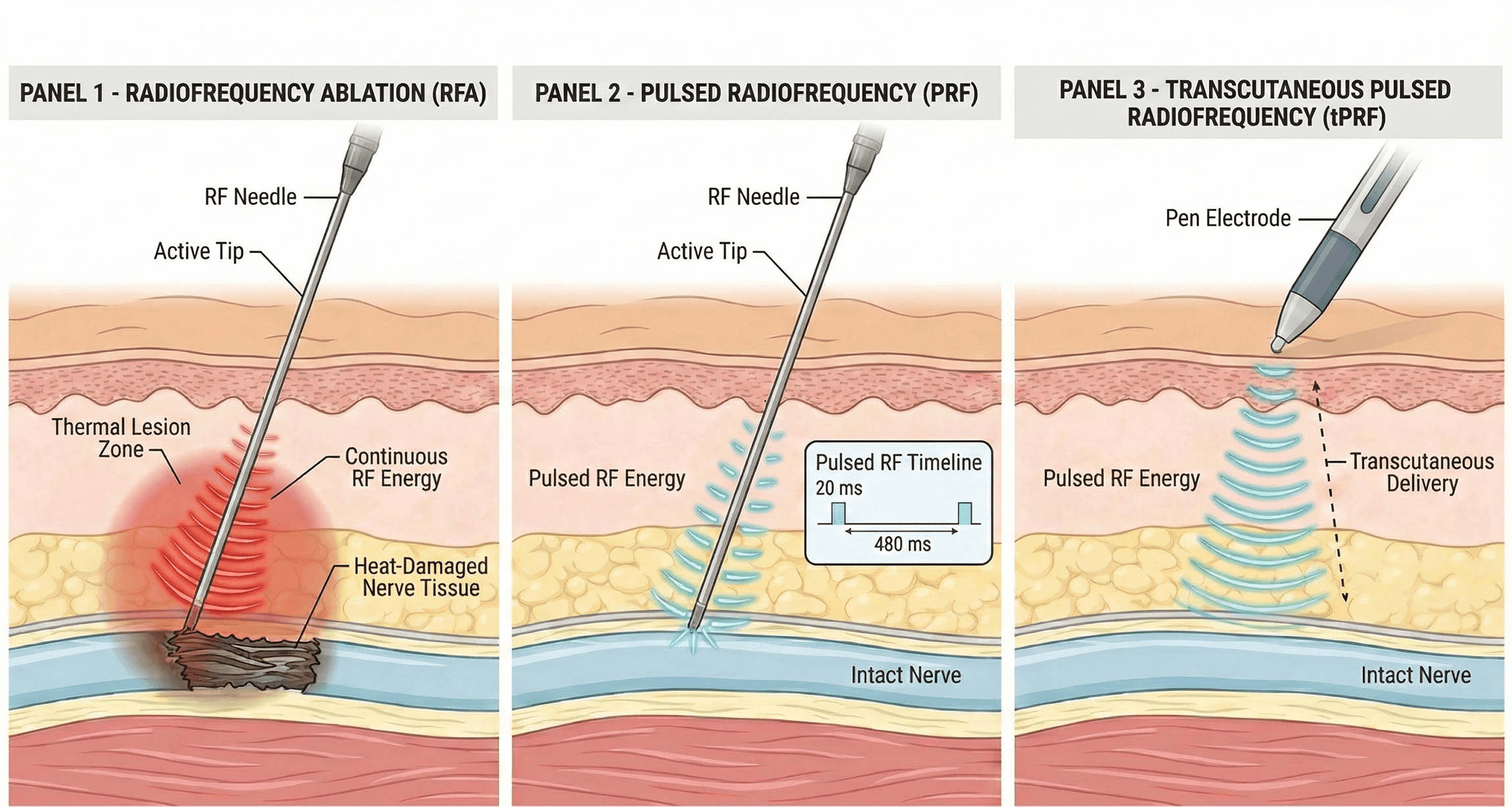
Decades ago, doctors discovered that they could use radio waves delivered through a specialized needle to generate localized heat. By carefully placing this needle next to a targeted nerve, they could use that heat to deactivate it and block pain signals from reaching the brain. This is known as continuous Radiofrequency Ablation (RFA).
While RFA can be effective for certain types of severe nerve pain, it has limitations. It relies on tissue destruction. The nerve is damaged, and while it stops sending pain signals, it can lead to numbness, and the nerve eventually regrows, sometimes bringing the pain back with it.
Step 2: The Breakthrough of Pulsed Energy
In the late 1990s and early 2000s, a breakthrough occurred. Researchers realized that if they applied the radiofrequency energy in brief, rapid pulses rather than a continuous stream, the tissue did not heat up to the point of tissue damage.
A foundational 2006 review by Cahana et al. highlighted this growing clinical shift, noting that patients were experiencing significant pain relief from these pulses without the destructive side effects of heat. It fundamentally shifted our understanding of radiofrequency use in medicine: the relief wasn’t coming from the heat destroying the nerve; it was coming from the electrical field itself.
Over the last few years, ongoing research has continued to explore exactly how this works. Menno Sluijter, one of the original pioneers of the therapy, proposed in a 2023 paper that PRF helps restore balance by reducing oxidative stress and modulating inflammation at a fundamental level. But how does this systemic effect translate to the nerve itself? A comprehensive review by Sam et al. (2021) suggested that PRF alters cellular signaling, calming down hyperactive pain receptors at a molecular level. Specifically, PRF has been shown to modulate the activity of microglia, the specialized immune cells surrounding the nerves that often act like fuel for chronic pain (Cho et al., 2013; Sam et al., 2021).
Evidence suggests that by quieting both the nerve and the local immune response, PRF acts less like a destructive fire, and more like a targeted modulation. This dual action is vital in interrupting the progression of central sensitization, the pathological process where the central nervous system becomes persistently hypersensitive to pain signals over time.
Evidence suggests that by stopping this cycle at the synaptic level, PRF sets the stage for deeper, lasting neuromodulatory effects. Emerging preclinical evidence (Occhigrossi et al., 2026) suggests that these electromagnetic fields might modulate pain pathways at an epigenetic level, meaning it could help regulate the genetic expression of chronic pain states.
Step 3: Taking the Needle Out of the Equation (tPRF)
Standard PRF is a massive leap forward from burning nerves, but it still requires a needle to be inserted into the body to deliver the energy directly to the targeted area.
This brings us to the latest evolution: Transcutaneous Pulsed Radiofrequency (tPRF). “Transcutaneous” simply means applied across the skin. By utilizing advanced delivery systems, we can now project similar neuromodulating electrical fields through the skin to target underlying tissues without needles.
tPRF is designed to leverage the foundational principles of Pulsed Radiofrequency therapy and make the delivery non-invasive.
The Bottom Line
We have moved away from the idea that we need to destroy tissue to stop pain. The evolution from RFA to PRF, and now to tPRF, represents a shift towards modulating the body’s pain signaling systems.
References & Further Reading
Cahana, A., Van Zundert, J., Macrea, L., van Kleef, M., & Sluijter, M. (2006). Pulsed radiofrequency: current clinical and biological literature available. Pain Medicine, 7(5), 411-423. PMID: 17014600
Sluijter, M. E., Teixeira, A., Vissers, K., Brasil, L. J., & van Duijn, B. (2023). The anti-inflammatory action of pulsed radiofrequency—A hypothesis and potential applications. Medical Sciences, 11(3), 58. PMID: 37755161 Free Full Text
Sam, J., Catapano, M., Sahni, S., Ma, F., Abd-Elsayed, A., & Visnjevac, O. (2021). Pulsed radiofrequency in interventional pain management: Cellular and molecular mechanisms of action – An update and review. Pain Physician, 24(8), 525-532. PMID: 34793641 Free Full Text
Cho, H. K., Cho, Y. W., Kim, E. H., Sluijter, M. E., Hwang, S. J., & Ahn, S. H. (2013). Changes in pain behavior and glial activation in the spinal dorsal horn after pulsed radiofrequency current administration to the dorsal root ganglion in a rat model of lumbar disc herniation: laboratory investigation. Journal of Neurosurgery: Spine, 19(2), 256-263. PMID: 23746090
Occhigrossi, F., Mosca, J., Micheli, F., Gazzeri, R., Robinson, C. L., & Lo Bianco, G. (2026). Pulsed radiofrequency and epigenetic modulation of pain pathways: A systematic review based on preclinical evidence. Journal of Pain Research, 19, 582117. PMID: 41737301 Free Full Text
Educational Disclaimer: This article is provided by Algiamed Technologies for general scientific and educational purposes only. It is intended to discuss the evolution and pre-clinical mechanisms of radiofrequency therapies. This information does not constitute medical advice, nor is it intended to promote the off-label use of any specific medical device. Patients should consult with their healthcare provider regarding appropriate treatment options.