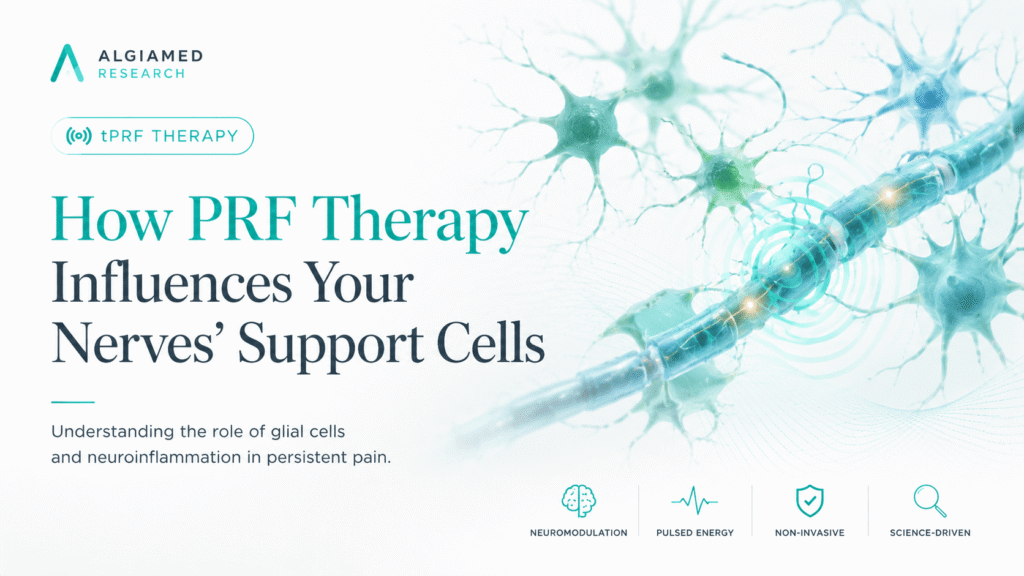
Understanding chronic pain requires looking beyond the nerve fibers themselves. It involves a complex interaction with the surrounding environment, specifically the glial cells. These specialized support cells are integral to neural health, regulating the chemical balance around nerves and providing essential structural stability.
However, research suggests that under persistent stress, such as nerve irritation or metabolic dysfunction, glial cells can shift into a hyper-active state.
The “Glial Problem” in Pain Research
Healthy glial cells keep nerves functioning smoothly. However, studies indicate that overactive glial cells can release inflammatory cytokines.
Multiple pre-clinical studies have shown:
- Microglia and astrocytes become activated during chronic pain states.
- These cells release cytokines such as IL-6, TNF-α, and IL-1β.
- This neuroinflammatory loop is a contributor to “central sensitization”, the state where the nervous system becomes hypersensitive.
How PRF Therapy is Being Studied in this Context:
Pulsed Radiofrequency (PRF) is a well-known modality for pain relief. Recent studies have highlighted the interaction between PRF and glial cells in pre-clinical, animal models of neuropathic pain.
1. Research on Microglial Activation (Pre-Clinical Data):
In a recent 2024 study published in the European Journal of Medical Research, Huang et al. investigated the effects of PRF in an animal model. In this study, which utilized direct surgical application of PRF to the nerve, the researchers observed:
- Upregulation of a protein called MG53.
- Subsequent inhibition of microglial activation.
- Reductions in neuropathic pain behaviors in the animal subjects.
2. Research on Segmental Effects of Microglial Activation (Pre-Clinical Data):
A study by Cho and colleagues (2016) examined glial activity after PRF treatment in a rat herniation model. This study utilized an invasive epidural catheter to deliver the PRF treatment following the experimental induction of pain via lumbar disc herniation. The researchers reported reduced markers of neuroinflammation and downregulation of microglia at both adjacent lumbar levels, as well as at the lumbar disc herniation level.
Why This Matters for Transcutaneous Stimulation:
While the studies above utilized invasive or surgical methods to deliver PRF energy, they provide insight into the potential underlying mechanisms of how PRF waveforms provide pain relief in animal models of neuropathic and neuroinflammatory pain.
At Algiamed, we are interested in how these mechanisms translate to non-invasive technologies. While the Stimpod NMS460 delivers PRF energy transcutaneously (through the skin), meaning the electric field strength differs from direct surgical application, understanding these cellular targets guides the ongoing refinement of our non-invasive waveforms.
Until clinical research confirms these specific cellular effects in humans, the Stimpod NMS460 leverages this advanced PRF technology to provide FDA-cleared symptomatic relief of chronic, intractable pain.
References:
Huang, Y., Huang, Y., Lv, X., Yu, Z., Qin, Y., Yang, X., An, S., Wo, C., & Wang, L. (2024). Pulsed radiofrequency alleviates neuropathic pain by upregulating MG53 to inhibit microglial activation. European Journal of Medical Research, 29(1), 578. https://doi.org/10.1186/s40001-024-02134-6
Cho, H. K., Kang, J. H., Kim, S.-Y., Choi, M.-J., Hwang, S. J., Cho, Y.-W., & Ahn, S.-H. (2016). Changes in Neuroglial Activity in Multiple Spinal Segments after Caudal Epidural Pulsed Radiofrequency in a Rat Model of Lumbar Disc Herniation. Pain Physician, 19(8), E1197–E1209.
SCIENTIFIC INFORMATION ON UNAPPROVED USES (SIUU) DISCLAIMER
This communication is intended for scientific and educational exchange with healthcare professionals. It summarizes peer-reviewed findings regarding potential mechanisms of action and emerging research applications.
Study Context: The studies cited utilized invasive/surgical delivery methods (epidural catheter/direct nerve contact) in animal models. The clinical efficacy of transcutaneous (surface) PRF in achieving these specific cellular outcomes in humans has not been established.
Regulatory Status: The Stimpod NMS460 is FDA-cleared for the symptomatic relief and management of chronic intractable pain and/or as an adjunctive treatment in the management of post-surgical pain and post-traumatic acute pain, as well as an adjunct for pain control due to rehabilitation exercises.
Limitation: Specific therapeutic applications, cellular mechanisms, or curative outcomes discussed in this content may not be approved or cleared by the FDA. This content is not intended as promotional labeling or to suggest clinical efficacy beyond the cleared indications.